
Plant Control Activity
Dear Long Lake Improvement Board Members:
Staff from the DNR, Michigan State University, and Progressive completed the annual point-intercept vegetation survey on Long Lake on August 12th. The following is a quick summary of our initial findings. We have not had a chance to do a QA/QC check on the data, so final numbers may change slightly.
-
Twenty-six species were documented during the 2026 sampling, which is the same number identified in 2025.
-
No Eurasian Watermilfoil was observed.
-
One site had Curly-leaf Pondweed.
-
Starry Stonewort was present at 47 sites but was not growing to the surface. For comparison, Starry Stonewort was found at 58 sites in 2025.
-
Native plants were broadly distributed at most sites shallower than 16 feet. Dominant species included Chara (Muskgrass), Robbins Pondweed, Illinois Pondweed, Water Celery, Variable-leaved Pondweed, and Coontail.
The final report for the vegetation survey will be available before the October 26th board meeting. Some property owners have expressed concerns about vegetation effects on navigation this summer. Prior to the board meeting, I will discuss the vegetation survey results with my DNR and EGLE colleagues and see if there is anything we can do to address landowner concerns while still providing adequate protection for Pugnose Shiners.
In my June 18th email to the lake board, I mentioned the presence of several weed rollers on the lake, and a DNR visit in July documented weed rollers or “muck blasters” (essentially water jets that disrupt the sediment and prevent plant growth) at 14 properties. Eight of those devices had been removed prior to our August 12th inspection. The six remaining property owners will be receiving a letter from EGLE informing them that the devices are unpermitted and must be removed.
In order to provide clarification regarding what types of vegetation control do or do not require a permit, EGLE and DNR staff developed a brief summary.
-
The following small-scale (e.g., clearing around a single residential dock) lakeshore management activities do not require a permit from EGLE or DNR.
-
Hand-pulling or cutting of submerged plants without the use of powered or mechanized tools provided that soil is not impacted and all plant fragments are removed from the water and properly disposed of on land above the ordinary high-water mark.
-
Hand-raking of bottomlands where vegetation is not present before raking, and where bottom lands are predominantly composed of sand or pebbles.
-
One-time cutting of emergent or floating leaf plants above the lake bottom provided that all plant fragments are removed from the water and properly disposed of on land above the ordinary high-water mark.
-
-
The following activities would require a permit from EGLE and DNR.
-
Use of chemicals for plant control.
-
Large-scale vegetation clearing.
-
Removing plants with powered or mechanized equipment.
-
Repeated hand-cutting of emergent or floating-leaf plants in an area that is considered wetland.
-
-
In some instances, extending a dock to deeper water would be a more environmentally friendly option than repeated vegetation clearing. See Docks, Boat Hoist, and Swim Rafts on Inland Lakes for information regarding permit requirements for dock installation.
I look forward to meeting with all of you on October 26th. Please feel free to reach out to me with any questions or concerns.
Brian Gunderman
Southern Lake Michigan Unit Manager
Michigan Department of Natural Resources – Fisheries Division
621 N. 10th Street
Plainwell, MI 49080
PLANT CONTROL INFORMATION
2026 Plant Control - See above
Check back in Spring, 2026 for updates.
2025 Plant Control
2024 Plant Control
2023 Plant Control
Aquatic Plants
Managing and controlling invasive aquatic species is a primary objective of the Long Lake Improvement Program.
In attempting to manage aquatic plants, it is important to note that aquatic plants are an important ecological component of lakes. They produce oxygen from photosynthesis, provide food and habitat for fish, and help stabilize shoreline and bottom sediments. The goal of the plant control program on Long Lake is to control invasive plant species while preserving beneficial plants.
The distribution and abundance of aquatic plants are dependent on several variables including light penetration, bottom type, temperature, water levels, and the availability of plant nutrients. The term "aquatic plants" includes both the algae and the larger aquatic plants or macrophytes. The macrophytes can be categorized into four groups: emergent, floating-leaved, submersed, and free floating. Each plant group provides unique habitat essential for a healthy fishery.


The aquatic plant control program has been ongoing on Long Lake for many years. The primary objective of the program is to prevent the spread of invasive aquatic plants while preserving beneficial native plant species. Plant control activities are coordinated under the direction of an environmental consultant, Progressive Companies. Scientists from Progressive conduct GPS-guided surveys of the lake to identify problem areas, and georeferenced plant control maps are provided to the plant control contractors. GPS reference points are established along the shoreline and over shallow portions of the lake. These waypoints are used to accurately identify the location of invasive and nuisance plant growth areas. Primary plants targeted for control with aquatic herbicides in Long Lake include Eurasian milfoil, curly-leaf pondweed, and starry stonewort. Starry stonewort and native aquatic plant growth impeding navigation are addressed with mechanical harvesting or select herbicide applications.
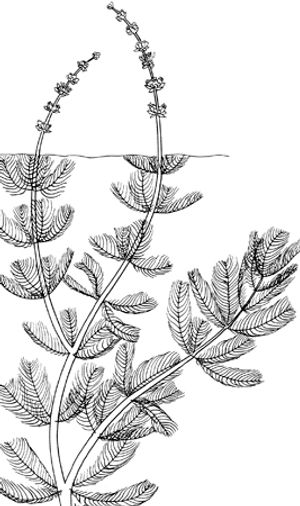
Eurasian milfoil

Starry stonewort

Curly-leaf pondweed

Plant biomass extracted from Long Lake - 2024
Plant Control Frequently Asked Questions
Who oversees the plant control program?
Plant control activities are coordinated under the direction of the lake board's environmental consultant, Progressive Companies. Scientists from Progressive conduct GPS-guided surveys of the lake to identify problem areas, and detailed plant control maps are provided to the plant control contractor. Follow-up surveys are conducted throughout the growing season to evaluate the effectiveness of the program.
Who conducts the herbicide treatments and mechanical harvesting?
Herbicide treatments and mechanical harvesting work in Long Lake are conducted by PLM Lake & Land Management Corp.
Who determines when and where treatments and harvesting will occur?
The timing and scope of plant control work is based on where nuisance plants are found when scientists from Progressive Companies conduct their surveys.
What plants are targeted for control?
The plant control program on Long Lake focuses primarily on invasive plants, such as Eurasian milfoil, starry stonewort, and curly-leaf pondweed. Invasive plant species have the potential to spread quickly if left unchecked.
How about a pre-emptive strike?
To be effective, aquatic herbicides must be applied directly to the plant beds when the plants are actively growing. There are no pre-emergence aquatic herbicides like there are for agriculture.
Why are there still plants in the lake following treatments or harvesting?
In managing aquatic plants, it is important to recognize that most plants are beneficial. Aquatic plants produce oxygen during photosynthesis, help stabilize shoreline and bottom sediments, and provide cover and habit for a variety of fish. The main objective of the plant control program on Long Lake is to control nuisance invasive species while maintaining beneficial plants. We do not want to remove all plants from the lake. This would negatively impact the fishery and cause many other problems such as algae blooms.
Are permits required?
In Michigan, a permit must be acquired from the Department of Environment, Great Lakes, and Energy (EGLE) before herbicides are applied to inland lakes. The permit lists the herbicides that are approved for
use, dose rates, use restrictions, and indicates specific areas of the lake where treatments are allowed. Permit requirements are designed to protect public health and the environment. Usually, no permits are required for mechanical harvesting. However, because the pugnose shiner, an endangered fish species, occurs in Long Lake, the Michigan Department of Natural Resources (DNR) requires a Threatened and Endangered Species Permit (TE 445) for the use of mechanical harvesting to cut and remove nuisance exotic and native aquatic plant biomass in the lake.
Can I apply herbicides myself?
If you have a permit from EGLE, you can treat your own shoreline, but we don’t recommend it. In most cases, it is best to have herbicides applied by a licensed professional applicator rather than attempting to apply herbicides yourself. If applied improperly, herbicides can do more harm than good.
How do herbicide treatments impact swimming and fishing?
All herbicides, except algaecides, formerly carried a 24-hour swimming restriction, but only in the area where treatment occurred as indicated by state-required posting signs. As of 2025, the State of Michigan no longer restricts activity in treatment areas. However, most applicators include language on the required postings asking people to avoid treatment areas on the day of application to prevent interference with treatment activities and to avoid unnecessary movement of water that could reduce treatment efficacy near the treated plant beds. If there are no posting signs, or the sign indicates that only algaecides were applied, there are no water use restrictions. There are no fishing restrictions for any herbicide treatments.
When can I water my lawn following a treatment?
If you draw water from the lake for irrigation, be sure to read the sign posted along your shoreline at the time of treatment. Most irrigation restrictions do not apply to established lawns. However, it you water flowers or a garden, you should adhere to the irrigation restrictions posted on the sign.
Why didn’t my property get a treatment notice sign?
If there is no sign posted along your property, it means your area was not treated and there are no use restrictions. State regulations require that areas within 100 feet of treatment areas be posted with a sign that lists herbicides applied and the associated use restrictions. Not every property gets treated every time; which properties get treatment depends on where the plants are found during lake surveys.
Is there a permanent fix to the problem?
If conditions are favorable, aquatic plants will grow. However, there are steps property owners can take to help minimize plant growth in the lake such as limiting the use of lawn fertilizers and maintaining natural vegetation along
the shoreline to prevent nutrients from washing into the lake.
What can I do to prevent the spread of aquatic invasive species in Long Lake?
To help prevent the spread of invasive species, state law requires drain plugs to be pulled, water to be drained, and plants and debris to be removed from boats and trailers before trailering. If you trailer your boat to other lakes, be sure to thoroughly wash your boat, motor, and trailer before launching back into Long Lake.